


Bedtime with a toddler is one of the most reliably exhausting parts of early parenting. The resistance, the requests for water, the sudden need for one more story, these are not random behavior.
A consistent toddlers bedtime routine addresses this directly. Not by eliminating the feelings, but by creating a predictable sequence of signals that tells the nervous system: sleep is coming.
1. Toddlers Sleep Better With Routine? Here Is What the Research Shows
The evidence behind bedtime routines is not anecdotal. Several well-designed studies have tested whether structured bedtime sequences actually change sleep outcomes in young children.
How Routine Helps Toddlers Fall Asleep Faster
A 2009 study in Sleep journal found that toddlers with a consistent 3-step bedtime routine fell asleep faster and slept more soundly than those without one. The effect appeared within a week of starting the routine.
A 2017 study in the journal Sleep Medicine reviewed sleep outcomes across 14 countries. It found that consistent bedtime routines were among the strongest predictors of better sleep duration and fewer nighttime wakings across all age groups studied, including toddlers ages one to three.
The consistency of the routine mattered more than the specific activities included in it.
What Happens to Toddlers When Bedtime Has No Structure
Without a consistent routine, toddlers lack the behavioral and physiological cues that shift the nervous system toward sleep. The result is overtiredness, which paradoxically produces resistance rather than tiredness.
A 2013 UCL study following over 10,000 children found that irregular bedtimes at age three were associated with behavioral difficulties that persisted into later childhood, suggesting sleep disruption has effects beyond the immediate night.
2. Toddlers Bedtime Routine: Step by Step
The following sequence covers the key elements of an effective toddler routine in the order they should happen.
Adjust timing and specific activities to fit your household, but maintain the sequence consistently.
Step 1: Wind Down With Quiet Play
Begin 45 to 60 minutes before target sleep time. Turn off screens, dim lights, and shift to low-stimulation activities.
Puzzles, drawing, building blocks, or looking at books together are appropriate. This transition signals that the high-energy phase of the day is ending.
Step 2: Warm Bath and Wash Up
A warm bath 30 to 45 minutes before bed is one of the most evidence-supported sleep aids for young children. Warm water raises skin temperature.
When the child gets out and the skin cools, core body temperature drops, which is a physiological trigger for sleep onset. The bath also provides a clear routine marker: after the bath, the day is over.
Step 3: Pajamas and Brush Teeth
Keep this step consistent and functional. Pajamas signal sleep readiness in the same way a uniform signals a role. Toothbrushing becomes habit through repetition at this age.
Using the same pajama routine, same toothbrush, and same sequence removes decision points that toddlers can turn into stalling opportunities.
Step 4: Storytime and Cuddles
One to three books, read in the same location every night (the toddler’s bed or a dedicated reading chair), provides the emotional connection and gentle language stimulation that wind-down requires.
Physical closeness during storytime reduces separation anxiety by meeting the attachment need before the lights go out rather than after.
Step 5: Lights Out and Comfort Object
End with a brief, consistent goodbye ritual: a goodnight phrase, a comfort object placed with the child, and lights off or dimmed to a night light level.
Keep the goodbye short and confident.
Prolonged lingering extends the transition and increases anxiety for both child and caregiver.
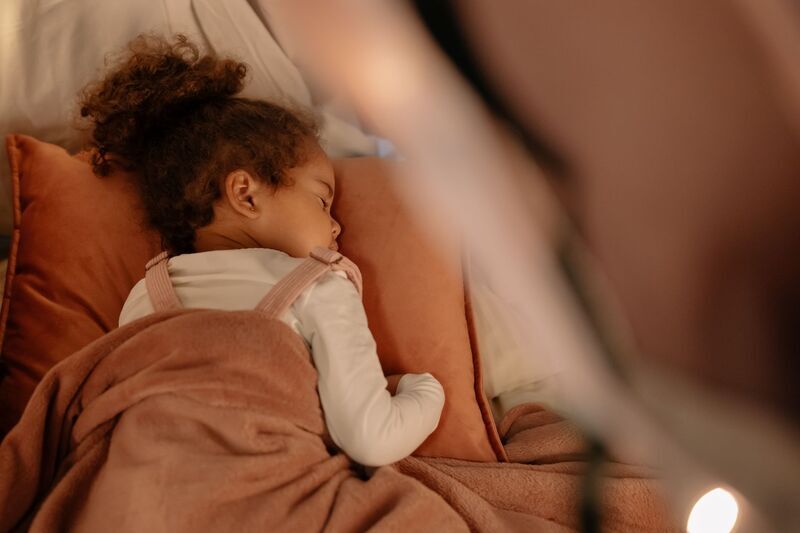
3. The Best Bedtime for Toddlers by Age
Toddlers bedtime routine changes across the toddler years, and target bedtimes should reflect actual sleep requirements rather than parental convenience.
- 12 to 18 months: 10 to 14 hours of total sleep per day including naps.
- Target bedtime: 6:30 to 7:30 PM. Most children this age still nap once or twice, which affects total nighttime sleep needs.
- 18 months to 2 years: 11 to 14 hours.
- Target bedtime: 7:00 to 8:00 PM. Naps typically consolidate to one per day around 18 months.
- 2 to 3 years: 11 to 14 hours.
- Target bedtime: 7:00 to 8:30 PM. Naps become shorter and some children begin dropping the nap between 2.5 and 3 years.
- 3 to 5 years: 10 to 13 hours.
- Target bedtime: 7:30 to 9:00 PM. Children who no longer nap need earlier bedtimes to accumulate sufficient total sleep.
Read more: Bedtime Routines for 2 Year Olds: A Step-by-Step Schedule That Works
4. How to Make a Bedtime Routine Chart for Toddlers
Visual charts work well for toddlers bedtime routine because they shift the authority from parent to the chart.
Instead of the parent telling the child what comes next, the chart does. This reduces power struggles significantly.
What to Include in a Visual Bedtime Chart
Use simple drawings or printed images representing each step: a toy (quiet play), a bathtub, pajamas, a toothbrush, a book, a moon or stars (lights out). Keep it to five to seven steps maximum.
More steps lose the child’s attention. Laminate the chart so it can be touched and pointed to. Post it at the child’s eye level in the bedroom.
How to Use the Chart With Your Toddler Each Night
Walk through the chart together at the start of the routine, pointing to each step. Let the child check off or flip a card for each completed step.
The sense of completion and agency this provides reduces resistance. Phrase the transition as the chart’s instruction rather than yours: ‘The chart says bath time’ lands differently than ‘I say bath time.’
5. Tips for Handling Common Bedtime Challenges
Even a well-established toddlers bedtime routine runs into resistance. Three specific challenges come up most frequently.
When Your Toddler Resists Bedtime
Resistance usually signals one of three things: the bedtime is too early (genuine not-tired), too late (overtired), or the transition is happening too abruptly.
Check the timing first. If the child lies awake for more than 20 minutes consistently, push the bedtime 15 minutes later. If the child is fighting sleep but clearly exhausted, move it earlier.
Separation Anxiety at Night
Separation anxiety peaks between 18 months and 3 years and is developmentally normal.
The most effective approach is predictable, brief goodbyes rather than extended ones. A consistent, short goodbye ritual (one song, one phrase, one hug) is more reassuring than a long, uncertain one.
If Your Toddler Keeps Getting Out of Bed
Return the child to bed immediately, every time, with minimal interaction.
One brief, calm statement (‘It is sleep time, I love you, goodnight’) and a return to bed, without extended conversation, negotiation, or engagement. Consistency across multiple nights is essential.
FAQs
How Long Should a Toddler Bedtime Routine Take?
Between 20 and 45 minutes is the practical range for most toddlers. Shorter than 20 minutes may not provide enough transition time for the nervous system to shift toward sleep. Longer than 45 minutes tends to extend stalling opportunities. A consistent 30-minute routine covering bath, teeth, pajamas, one or two books, and goodnight covers the key elements efficiently.
What Time Should Toddlers Go to Bed?
Between 7:00 and 8:30 PM for most toddlers between 18 months and 4 years, adjusted for nap timing and wake time. Children who wake between 6:00 and 7:00 AM typically do best with a 7:00 to 7:30 PM bedtime.
Children who wake later can sustain an 8:00 to 8:30 PM bedtime comfortably. The AASM recommends 11 to 14 hours of total sleep for this age group.
Should the Toddlers Bedtime Routine Be the Same Every Night?
Yes, as consistently as possible. The research supporting bedtime routines specifically demonstrates that consistency, not variety, produces the sleep benefits. The sequence, timing, and activities should remain stable even when other aspects of the day vary.
Conclusion
A consistent toddlers bedtime routine is one of the most evidence-supported interventions available to parents of young children.
The research is clear: predictable sequences reduce sleep onset time, decrease nighttime wakings, and have behavioral benefits that extend beyond the night.