

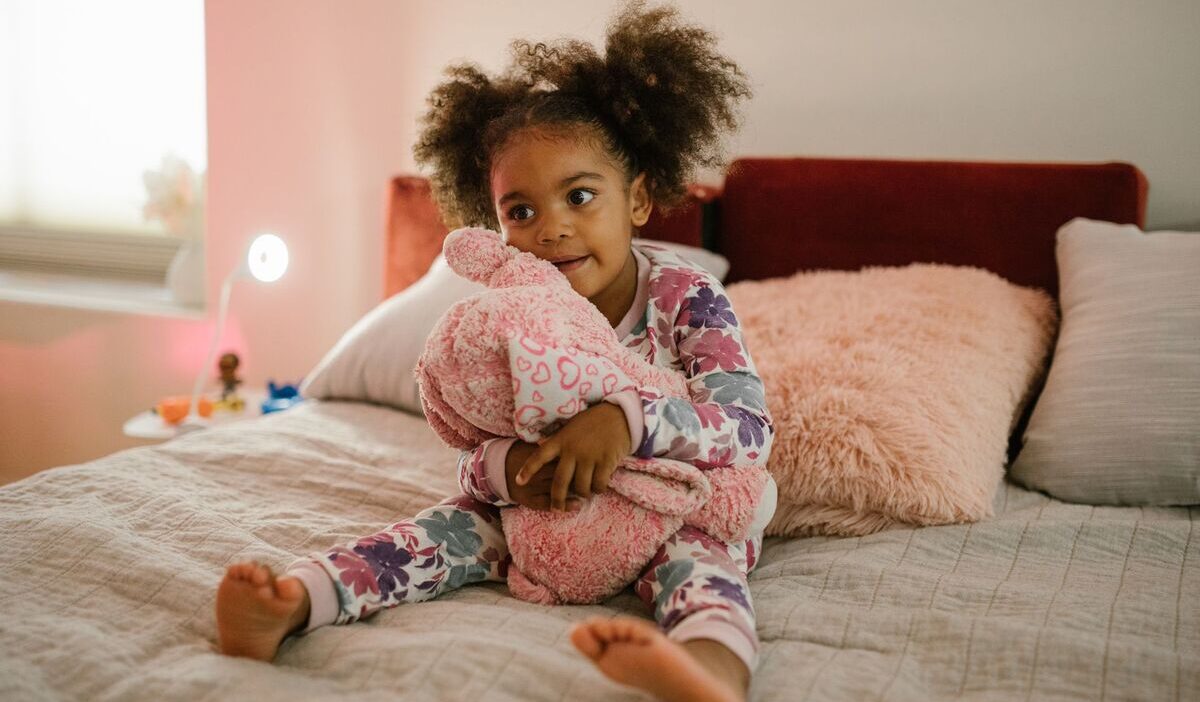
Most 3 year olds need 10 to 13 hours of total sleep across a 24-hour period, including any nap.
This guide breaks down how much sleep does a 3 year old need, what that looks like in practice, with sample schedules for both napping and non-napping children.
How Much Sleep Does a 3 Year Old Need?
The total sleep target is consistent across major pediatric sleep guidelines, though the split between night sleep and nap sleep varies by child.
Recommended Total Sleep Hours per Day
The American Academy of Pediatrics and the American Academy of Sleep Medicine recommend 10 to 13 hours of sleep per 24-hour period for children ages 3 to 5, which includes naps.
The CDC’s sleep guidelines for children also fall within this range and note that consistent sleep schedules support healthy growth, attention, and behavior at this age.
Falling consistently below 10 hours, even with a nap included, is associated with more behavioral difficulties, attention problems, and emotional regulation issues during the day.
Falling above 13 hours regularly is less common but can sometimes signal that bedtime is too early relative to the child’s actual sleep need, leading to long periods of lying awake.
How Much Night Sleep vs. Nap Sleep at Age 3
For a 3 year old who still naps, a typical split is 10 to 11 hours overnight and 1 to 2 hours during the day, totaling 11 to 13 hours. For a 3 year old who has dropped the nap, the full 10 to 13 hours needs to come from nighttime sleep alone, which usually means an earlier bedtime to compensate.
The nap itself becomes less predictable around this age. Some children nap daily until 4, others drop it closer to 3. The transition is often gradual: a child may nap five days one week and skip it twice the next. Treat the nap as flexible during this window rather than enforcing it on a fixed schedule.
What Time Should a 3 Year Old Go to Bed?
Bedtime depends on wake time, nap status, and how the total sleep hours add up across the day. There is no single correct clock time, but there is a workable range.
Best Bedtime Window for 3 Year Olds
For a napping 3 year old who wakes around 6:30 to 7:00 AM and naps from roughly 1:00 to 2:30 PM, a bedtime of 7:30 to 8:00 PM works well.
For a non-napping 3 year old with the same wake time, bedtime should move earlier, typically 6:30 to 7:30 PM, to make up for the lost nap hours within the 10 to 13 hour total.
How to Adjust Bedtime When Naps Are Dropped
When a nap disappears, the lost hours need to go somewhere, and bedtime is usually the answer. Move bedtime 30 to 45 minutes earlier in the first week after the nap stops, then reassess.
Expect a rough adjustment period of one to two weeks where the child may be more tired than usual in the late afternoon.
You may also interested in: Bedtime Routines for 2 Year Olds: A Step-by-Step Schedule That Works
What Are Signs a 3 Year Old Isn’t Sleeping Enough?
Sleep deficits at this age often show up as behavior rather than obvious tiredness, which makes them easy to miss.
- Meltdowns and emotional outbursts that seem disproportionate to the trigger, particularly in the late afternoon or early evening.
- Hyperactivity or wired behavior in the evening, which is frequently mistaken for not being tired when it is actually a sign of overtiredness.
- Waking up earlier than usual combined with difficulty getting going in the morning.
- Increased clumsiness, more frequent minor accidents, or noticeably reduced patience with tasks the child normally manages well.
- Resisting naps but then falling asleep unexpectedly in the car or during quiet activities.
Sample Sleep Schedule for a 3 Year Old
These two sample schedules total within the recommended 10 to 13 hour range and can be shifted earlier or later depending on your child’s natural wake time.
Sample Schedule With a Nap
- 7:00 AM: Wake up
- 1:00 PM to 2:30 PM: Nap (1.5 hours)
- 7:30 PM: Bedtime routine begins
- 8:00 PM: Lights out
- Total: 11 hours overnight + 1.5 hours nap = 12.5 hours
Read more: Guide to Creating an Ideal Toddlers Bedtime Routine
Sample Schedule Without a Nap
- 7:00 AM: Wake up
- 1:00 PM: Quiet rest time, 20 to 30 minutes (no sleep expected)
- 6:45 PM: Bedtime routine begins
- 7:15 PM: Lights out
- Total: 11.75 hours overnight

Tips for Better Sleep at Age 3
Two areas make the biggest difference in sleep quality at this age: the routine leading into bedtime and the physical environment the child sleeps in.
Building a Calming Bedtime Routine
A short, consistent sequence, bath or wash up, pajamas and teeth, one or two books, lights out, works well at this age and typically takes 20 to 30 minutes.
Starting the wind-down 30 to 45 minutes before lights out gives the body time to shift toward sleep before the formal routine even begins. Consistency matters more than the specific activities chosen.
Setting Up a Sleep-Friendly Environment
The room should be dark, cool (around 68 to 72°F), and quiet. A night light is fine if the child has developed a fear of the dark, which is common starting around this age.
Remove screens from the bedroom entirely. Screen exposure in the hour before bed delays melatonin production and is one of the most common hidden contributors to bedtime resistance and delayed sleep onset at this age.
FAQs
Is 10 Hours Enough Sleep for a 3 Year Old?
10 hours is at the lower end of the recommended 10 to 13 hour range and is enough for some children, particularly if it includes a nap or the child is a naturally lower-sleep-need child.
If a child sleeping 10 hours shows signs of insufficient sleep, such as frequent meltdowns or morning grogginess, aim for closer to 11 to 12 hours by adjusting bedtime earlier.
Why Does My 3 Year Old Fight Sleep Every Night?
Fighting sleep is often a sign of overtiredness rather than not being tired enough. An overtired body produces more cortisol, which creates a wired, resistant state at bedtime.
Try moving bedtime 15 to 30 minutes earlier for a few nights and see whether resistance decreases. Inconsistent routines and screen use close to bedtime are the other most common contributors.
Should a 3 Year Old Sleep in Their Own Bed?
Most 3 year olds are developmentally ready to sleep independently in their own bed, and independent sleep is associated with better sleep quality for both children and parents. If a child has been co-sleeping, transitions work best when introduced gradually and paired with a consistent bedtime routine and a comfort object, rather than made abruptly.
Conclusion
How much sleep does a 3 year old need? The target is 10 to 13 hours total across a 24-hour period, whether that comes from night sleep alone or a combination of night sleep and a nap.
The right bedtime depends on wake time and whether your child still naps, but sleep latency of 15 to 20 minutes is the most reliable signal that the schedule is working.